

The Five Most Outrageous Points in the 28-Point Peace Plan for Ukraine
The US plan to end the war in Ukraine not only favors Russia (the aggressor) and punishes the victim (Ukraine). It also underscores how the US no longer views Europe as essential to its security.

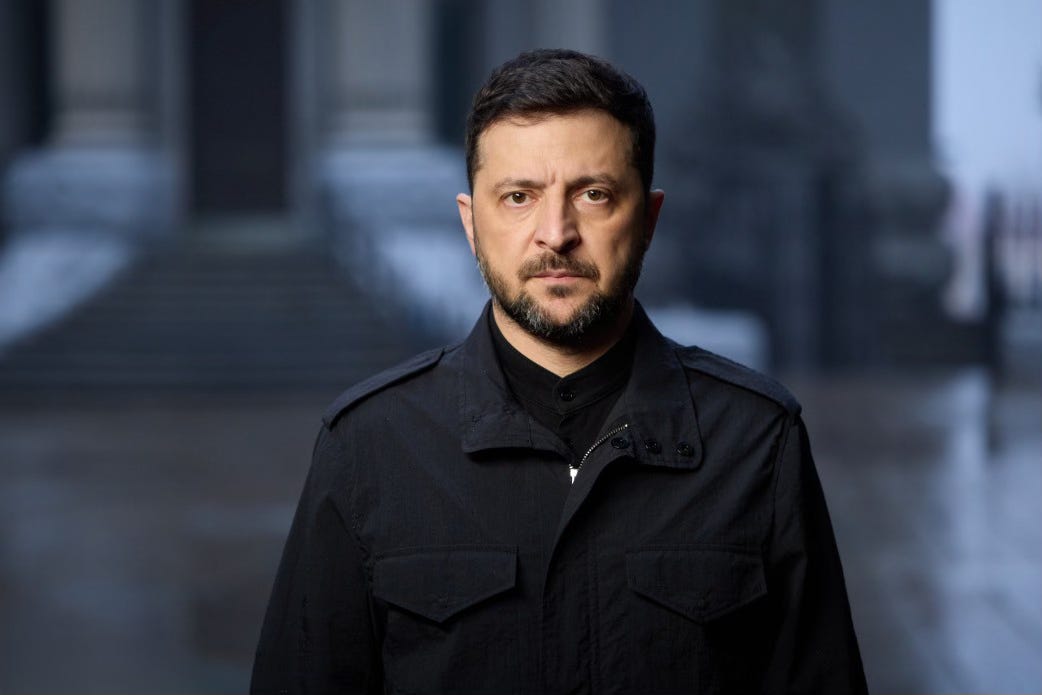
On Friday morning, Vice President JD Vance got on the phone to Ukrainian President Volodymyr Zelensky. He had a clear message: Agree to the 28-point plan that the US presented previous day or lose all US military and intelligence support. The deadline for agreeing was set for Thanksgiving, 6 days from now.
It was an extraordinary way to treat a head of state of a country at war—the victim of an aggression its much larger neighbor Russia had instigated 11 years earlier. But, then, Zelensky was used to being treated this way by his American interlocutors. When he visited Washington in February for his first meeting with President Donald Trump in the second term, he was castigated for not being sufficiently thankful, not wearing a suit, not having any cards, and threatening World War III. All on live television.
Eight months later, Zelensky returned to Washington in the hope of getting long-range, Tomahawk cruise missiles. Instead, he got another lecture from the US president. Throwing maps on the table, Trump demanded Ukraine give up all of the Donbas region—even the part it had been fighting to secure for 11 years. “If [Putin] wants it,” Trump told Zelensky, “he will destroy you.” This time, the argument was held behind closed doors.
It was after this latest meeting between the US and Ukrainian leaders that Trump made two decisions. One was to impose oil sanctions on Russia’s two largest oil companies. The other was to authorize his peace envoy, Steve Witkoff, to try and draw up a plan to end the war.
Witkoff retreated to his estate in Maimi and got to work. He was joined a week later by Kirill Dmitriev, the head of Russia’s sovereign wealth fund who Putin had appointed his key envoy on Ukraine. They got to work on a plan that ended up in the 28 points Ukraine now needs to accept or risk losing all US assistance. Dmitriev, predictably, was happy with the results. “We feel the Russian position is really being heard,” the Russian told Axios, which broke the story about the plan.
No kidding. The 28 points are in essence a forced capitulation of Ukraine. It gives Russia most of what it wants—on territory, on NATO, and on security. It also gives the United States economic benefits that are unique in agreements like these. And it leaves Europe with new obligations in which none of the countries have had a say.
To get the full flavor of the plan, it’s important to read all 28 points and the additional security guarantees framework in full. Here, let me highlight five aspects of the plan that are truly extraordinary:
1. European Security
The plan recognizes that the war in Ukraine affects European security. In one sense, this is positive. The security guarantees to be provided to Ukraine state that “a significant, deliberate, and sustained armed attack by the Russian Federation across the agreed armistice line into Ukrainian territory shall be regarded as an attack threatening the peace and security of the transatlantic community.”
But this welcome recognition that Ukraine’s security is linked to that of the “transatlantic community” is undermined by the idea that the armed attack triggering the security guarantee must be “significant, deliberate, and sustained.” NATO’s article 5 guarantee only mentions an “armed attack.”1 There are no ifs, ands, or buts. Adding the modifiers risks debate about what is significant, deliberate, and sustained about the attack. That undermines deterrence and reassurance.
Worse are the plan’s provisions to address fundamental issues of European security, mainly in ways that Russia has long sought. Perhaps Witkoff wasn’t aware that Russia presented the United States and NATO with draft treaties in late 2021 that sought to reverse the post-Cold War security order. But knowingly or not, some of the provisions in the 28-point plan seek to do just that. For example, point 2 states:
A comprehensive non-aggression agreement will be concluded between Russia, Ukraine and Europe. All ambiguities of the last 30 years will be considered settled.
Russia has sought such a pact for decades. It’s meaningless, especially since it is Russia that has engaged in aggression since its 2008 invasion of Georgia, contrary to international laws. And what are the “ambiguities of the last 30 years” that “will be considered settled?” This gives Moscow carte blanche to insist on its interpretation of past events and ignore those of Europe.
There is much more that is objectionable. (Point 9, for example, states “European fighter jets will be stationed in Poland.” Poland is a member of NATO. Russia is a European country. The United States and Canada, both NATO members, are not European countries. Does this mean Russian fighters “will be stationed in Poland” but not US or Canadian fighters. You get the point.)
2. Profiting from War and Peace
A particularly odious part of the plan are those points that provide the United States with economic benefits unrelated to any historical expense or pretense. Point 10 details the “US guarantee,” and notes that “the US will receive compensation for the guarantee.” Yet, this smacks more of a protection racket than a security guarantee. The latter is based on the idea that preventing a return to war is in the fundamental interest of the United States and, as the plan says, the “transatlantic community.” But receiving payment for the guarantee is a form of profiteering rather than a core security objective. As a result, either the US military is for sale (which would be news to most Americans) or the security guarantee isn’t credible and reliable.
Having already extracted an economic return for future investments in Ukraine in a separate deal Washington negotiated with Kyiv some months ago, point 14 of the plan now provides for additional economic profit for the United States by giving the US “50% of the profits” from a US-led venture to rebuild Ukraine. And the funding for that venture comes not from the US treasury, but from $100 billion of redirected frozen Russian assets and another $100 billion to be provided by Europe.
As for the remainder of Russia’s frozen assets, rather than using them for the reconstruction of Ukraine, the plan says they:
will be invested in a separate US-Russian investment vehicle that will implement joint projects in specific areas. This fund will be aimed at strengthening relations and increasing common interests to create a strong incentive not to return to conflict.
In other words, the United States will stand to benefit uniquely once again.
3. Welcome to the World, Russia.
The long-term benefits of this agreement redound overwhelmingly to Russia, the aggressor, not to the victim, Ukraine. The core provision is point 13:
Russia will be reintegrated into the global economy:
The lifting of sanctions will be discussed and agreed upon in stages and on a case-by-case basis.
The United States will enter into a long-term economic cooperation agreement for mutual development in the areas of energy, natural resources, infrastructure, artificial intelligence, data centers, rare earth metal extraction projects in the Arctic, and other mutually beneficial corporate opportunities.
Russia will be invited to rejoin the G8.
So sanctions will be lifted (no word here on coordination among Europe, the United States, and others), the US will start a long-term economic relationship with Russia, and Russia gets to rejoin the very group that was so effective in coordinating the response to Russia’s aggression.
4. The United States vs. NATO
The drafter of these points does not seem to be aware that the United States is a member of NATO—indeed, a founding member who has been the unabashed leader of NATO for more than 75 years. Take point 4:
A dialogue will be held between Russia and NATO, mediated by the United States, to resolve all security issues and create conditions for de-escalation in order to ensure global security and increase opportunities for cooperation and future economic development.
How does the United States, a member of NATO, mediate a dialogue between Russia and NATO? Only if it isn’t a member. But as far as we know, the United States has not invoked Article 13 of the North Atlantic Treaty under which it gives notice of its intent to withdraw from NATO in one year.
But this is hardly the only time Witkoff ignored the fact that the US is a NATO member. The security guarantees that are to provided to Ukraine are to be signed by the United States and NATO (as well as the European Union, Ukraine, and Russia). And their implementation will be directed by the president of the United States “in consultations with Ukraine, NATO, and European partners.” Finally “NATO members … affirm that Ukraine’s security is integral to European stability and commit to act in concert with the United States in responding to any qualifying violation.”
In all these cases, NATO and the United States are describe as different, independent actors. But as a member of NATO, the United States is integral to what NATO decides and does. Indeed, the United States controls the military command structure of NATO and any military action by NATO can only occur with full participation of the United States.
5. Where is Ukraine? Or Europe?
I have left the biggest outrage for the last. Here is a 28-point plan that was negotiated with Russia and presented to Ukraine as a fait accompli. That’s not how anyone negotiates or how wars end. If Ukraine had wanted to surrender, it could have done that a long time ago. To think it will do so after 4 years of intense fighting, giving up much more than it has today, shows the drafters have no understanding of the conflict. That’s not a surprise. Witkoff talks a good game with his Russian buddies. But he’s never been to Kyiv or taken the time to learn what motivates Ukraine to fight. Like Trump, he blames both sides for the war and thinks that the stronger party should get what it wants and the weaker one should just agree.
And then there is the absence of Europe. The agreement is full of demands on what the Europeans must do and cannot do. Europe will sign on to the security guarantee. It will engage in a dialogue with Russia on security. It will open its markets to Ukraine. It will unfreeze Russian assets and pay $100 billion into a reconstruction fund. But, it won’t deploy troops in Ukraine as part of the security guarantee. It will defer to a US-Russian working group to oversee the agreement’s implementation, but have no seat at the table. It will amend the NATO treaty to prevent Ukraine or anyone else from joining NATO.
All this, without any consultation, discussion, or even a briefing. It’s hard to think of a more amateurish way to try to end the war than this. This isn’t diplomacy. It’s delusional
The tragedy is that the war will continue. The costs will rise for everybody. And the end will be yet further away. A serious effort, focused on supporting Ukraine and pressuring Russia, might have produced results. But this plan isn’t serious. It’s insulting.
Interestingly, the only time Article 5 was invoked came after the September 11 attacks on the United States. Its formal application was delayed until the United States presented intelligence demonstrated that the armed attack came from a foreign source.
Europe should have defended Ukraine after 2 years of Russian aggression.